Log BPC-157 on your iPhone
Track BPC-157 entries on iPhone, use PepLedger’s on-device reconstitution calculator, and keep the app’s limits clear. Not medical advice.
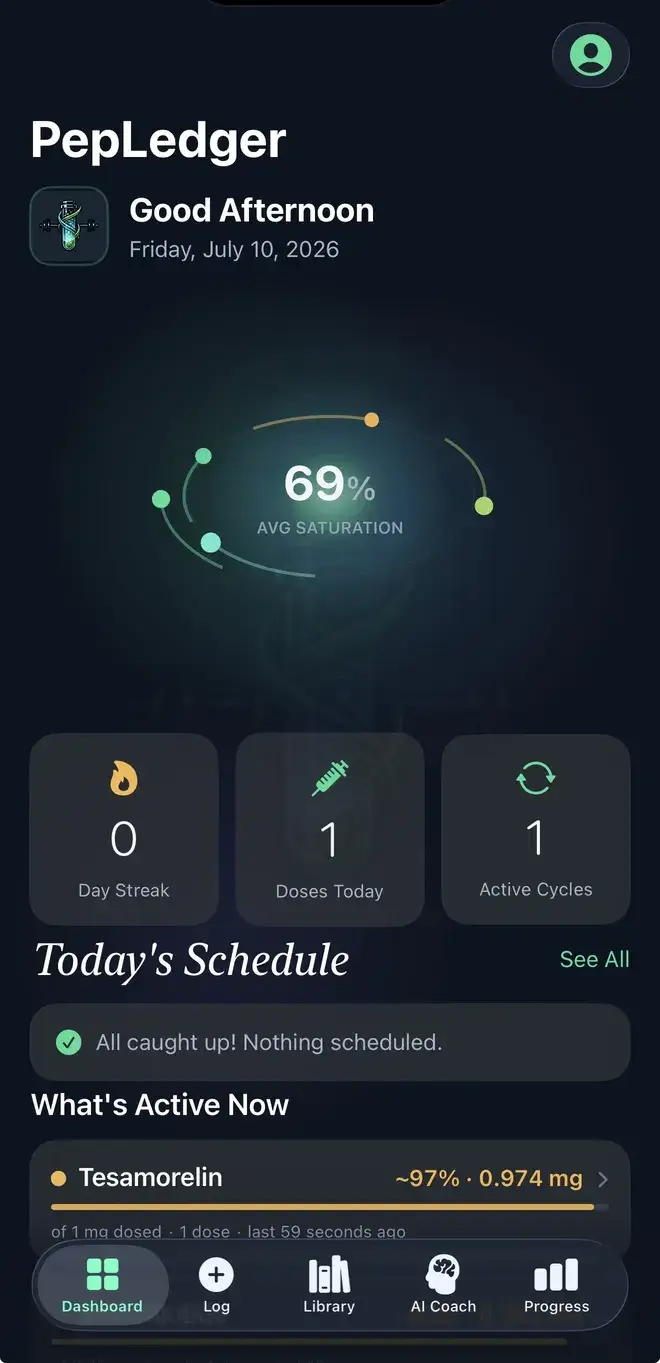
Build a BPC-157 entry from source details
BPC-157 records can contain details that are hard to recover later: spelling used on a label, unit copied into a note, date an entry was made, and source a user chose to retain. PepLedger offers an iPhone record for those details without turning them into a conclusion. BPC-157 has no FDA-approved dosing or titration schedule; any cadence in a personal record is only user-entered context. What’s Active Now is not a blood test or product check.
Start by recording what happened rather than what was intended. Enter the reference name, amount, unit, date, time, method, and site. Add label wording, lot or container notes, liquid-volume notes, and the source you chose to keep. If you correct a transcription, say so in the note. Inventory and expiration fields can sort personal paperwork; a reminder can prompt review. Neither field determines storage, identity, quality, suitability, or safety.
Make BPC-157 arithmetic visible, not directive
The BPC-157 reconstitution calculator can show arithmetic from a labeled amount, liquid volume, and syringe scale that you enter. Recheck values against documentation available to you before saving a note. A calculated output is arithmetic, not an instruction, and does not verify what is in a container. Preserve original values beside a result so a later reader can see what was supplied.
Review without adding conclusions
Use history to find missing dates, duplicate entries, mixed mg and mcg notation, or a note that should stay separate from an event. A dated observation, measurement, or selected laboratory value can provide context. The app organizes those items; it does not infer that one caused another or interpret a result. An active estimate depends on user-entered timing, units, and a configured assumption, not a laboratory measurement or individualized model.
The record belongs to its user: name, amount, unit, date, time, method, site, source note, inventory detail, observation, and laboratory value. PepLedger does not independently verify these inputs and does not claim to validate BPC-157, a treatment, or any material represented by a note. Read About PepLedger, the methodology, and the Privacy Policy.
Official app and clear boundaries
PepLedger runs on iPhone and iPad with iOS 18 or later and is not a clinic portal or medical device. Current Pro features and pricing appear in the app. Open the official PepLedger App Store listing. It does not sell BPC-157, validate a product or treatment, or advise an amount or timing. Nothing here is medical advice; consult a qualified healthcare professional for personal questions.
Prepare BPC-157 notes for review
When reviewing a BPC-157 history, start with the original source detail and work forward through dated entries. Flag an unknown unit, a missing time, or an amended note instead of silently filling the gap. A checklist of source, event, note, and observation helps a reader understand which parts came from the user and which remain uncertain.
PepLedger can make questions easier to organize, but it cannot tell whether a BPC-157 product is genuine, suitable, or safe, and it cannot turn arithmetic into guidance. A well-kept record describes what was entered; it does not establish a medical conclusion. Keep that boundary visible when discussing personal information.
When a record is revisited, compare the timeline with the source note and identify which details remain uncertain. A correction can be useful without erasing the earlier entry. This gives a later reader a transparent account of the user-entered history rather than an appearance of independent confirmation. The app preserves a note; it does not turn uncertainty into a verified fact. Keep the source and screen wording together when they differ. A later reader can then ask a precise question instead of guessing what the original note meant. The record remains attributable to its author. That is the intended scope of the tracker and its editorial boundary.