What half-life means for a dose you already logged
What half-life means for a logged dose, why PepLedger shows an estimate, and how What's Active Now works. iPhone only. Not medical advice.
Half-life in plain language
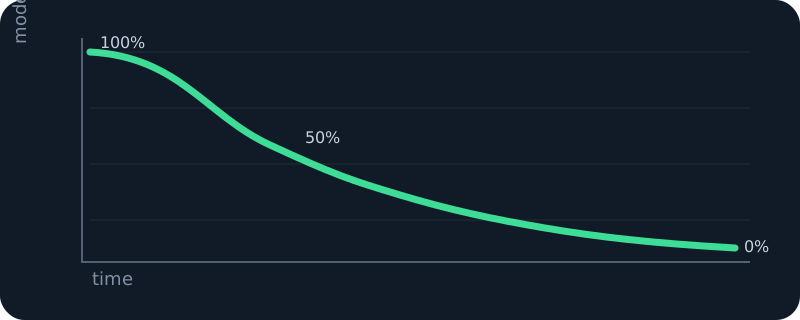
Half-life is the time a modeled amount takes to fall to half of its earlier value. If a hypothetical amount starts at 100 units and the model uses a 10-day half-life, it shows 50 units after 10 days, 25 after 20 days, and 12.5 after 30 days, before considering any new event. This is a mathematical description, not a promise about a person or a product.
Half-life is not the same as duration of an effect, time to onset, time to peak, or time until nothing remains. Absorption, distribution, metabolism, formulation, route, timing, measurement method, and individual variation can all affect observed exposure. A published value may describe a particular study population and context rather than an individual result. For that reason, a half-life estimate should not be used to select an amount, interval, or treatment decision.
How PepLedger uses an estimate
When a user logs an event, PepLedger can place it on a timeline and show an estimated view of what may still be active. The estimate uses the configured compound assumption and the dates and amounts entered. Repeated events can overlap mathematically, so the display may rise after a new entry and decline between entries. It is designed for organizing a record and noticing timing patterns, not for reconstructing a blood concentration.
A hypothetical user could log an event on Monday and another seven days later, then review the timeline alongside a note or body measurement. The proximity of two records does not show that one caused the other. Missing entries, incorrect units, a mislabeled compound, changing formulations, and an unsuitable half-life assumption can all make the visualization misleading.
Why the estimate has boundaries
A simple half-life model generally treats an entered event as a predictable amount that declines smoothly. Real-world observations may not follow that shape, and the model does not account for every biological process, laboratory method, formulation difference, or data error. It also cannot tell whether a record is complete. Use the display to ask better questions about the timeline, not to infer a concentration or make a health decision.
Questions and limits
Is the active-system display a lab result?
No. It is an educational estimate, not a laboratory measurement, diagnosis, or individualized pharmacokinetic model.
Can I use half-life to plan a protocol?
No. This page explains a logged record and a simple model; it does not recommend a dose, schedule, washout, or treatment.
To explore the underlying arithmetic without using personal health claims, try the GLP-1 level plotter. To keep a private timeline, see the PepLedger tracker. All information here is general and non-medical; consult a qualified professional for personal questions.