See what's still active in your system.
Private iPhone peptide tracker for doses, cycles, notes, bloodwork, and protocol history. See logged-activity estimates with clear limits; not medical advice.
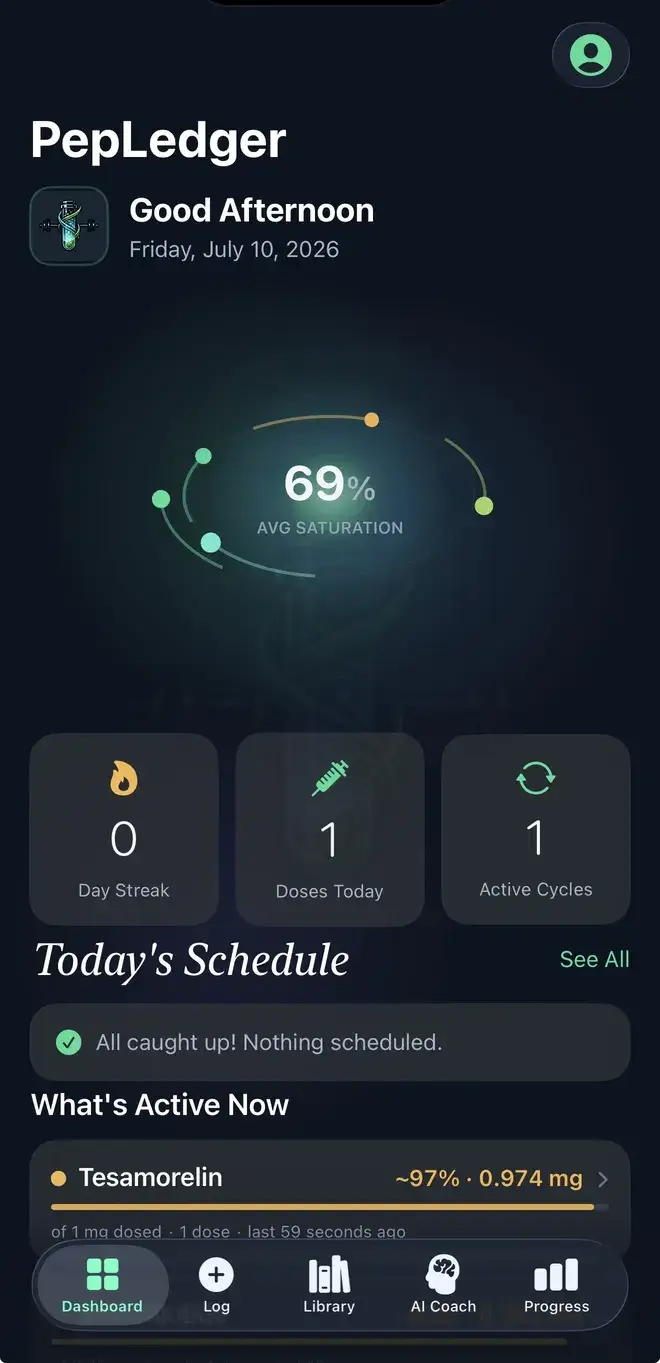
What the tracker records
PepLedger organizes user-entered compounds, amounts, units, dates, times, methods, sites, schedules, notes, inventory, body measurements, and selected bloodwork. Quick Log is intended for recording an event without rebuilding the surrounding protocol each time. Cycle records group schedules and notes so earlier entries remain reviewable.
Inputs and outputs
The tracker depends on the names, dates, units, intervals, and other details entered by the user. It turns those inputs into a private timeline, schedule view, inventory status, progress history, and an estimated active-system visualization. The estimate is based on configured half-life assumptions and logged timing; it is not a laboratory measurement.
Hypothetical example
A hypothetical user might record an event on Monday, attach it to an existing cycle, and later compare that log with a body measurement entered on Friday. PepLedger preserves the sequence and can display an educational remaining-amount estimate. The example does not imply that the events caused the measurement change.
Common tracking errors
- Mixing mg and mcg between entries.
- Entering a planned event as though it already occurred.
- Using an assumed half-life as personal pharmacokinetic data.
- Drawing causal conclusions from two values that merely occurred near each other.
Frequently asked questions
Does PepLedger prescribe or recommend protocols?
No. It organizes information entered by the user and does not prescribe, diagnose, or recommend treatment.
Is the active-system view a blood-level result?
No. It is an estimate, not a laboratory value or individualized pharmacokinetic model.
For focused recordkeeping, read the GLP-1 tracker guide, BPC-157 tracker guide, TB-500 tracker guide, semaglutide tracker guide, tirzepatide tracker guide, retatrutide tracker guide, and testosterone tracker guide. Each page describes user-entered records and its limits; none validates a product, treatment, or compound.
Related tools: use the peptide reconstitution calculator, check a GLP-1 concentration against U-100 units, convert syringe units to mg with a verified concentration, or explore a repeated-event decay estimate. You can also record the arithmetic and your own entries in the PepLedger tracker.
Limitations: This calculator performs arithmetic on values supplied by the user. It does not identify a product, validate a label, check sterility or potency, recommend an amount, or replace a pharmacist, prescriber, or other qualified healthcare professional. It is informational and is not medical advice.