A private tirzepatide log on iPhone
Track tirzepatide entries on iPhone with history, reminders, and an optional activity estimate from logged doses. PepLedger is not medical advice.
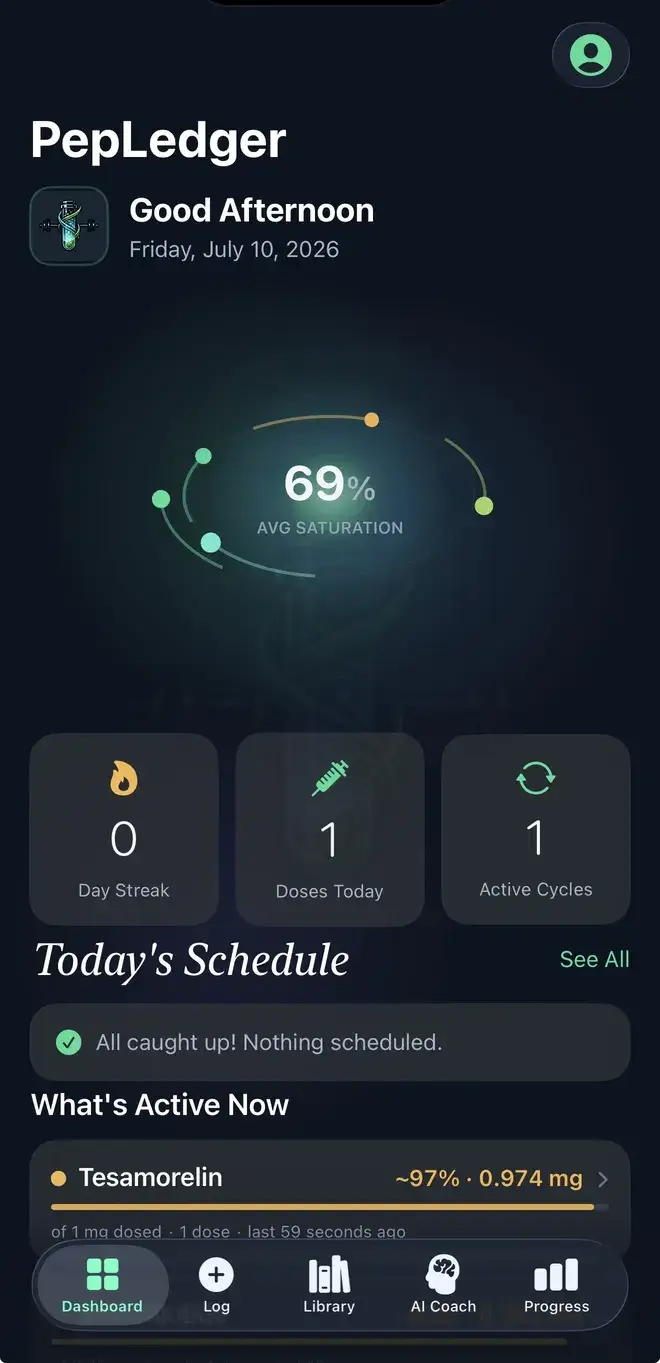
Capture tirzepatide details in sequence
Tirzepatide recordkeeping works best when an entry can be read without guessing which unit, date, or label note belonged to it. PepLedger offers a private timeline for information a user chooses to enter on iPhone. FDA labeling for Mounjaro and Zepbound describes once-weekly administration and product-specific escalation; that context does not turn this tracker into a schedule. What’s Active Now is not a lab result.
Save a completed event with its date and time, then add the amount and unit as written in your source. Record method and site separately from a note about a label, container, or later correction. This distinguishes an event from surrounding paperwork. Reminders can prompt a review, while inventory and expiration fields keep personal notes together. None establishes identity, quality, storage, safety, or suitability.
Check entered tirzepatide arithmetic
The tirzepatide reconstitution calculator can expose arithmetic from values you enter. Retain source values and check them against documentation available to you. A result does not confirm a container or tell anyone what to do. The half-life guide explains why a mathematical estimate is not a measurement and not an individual result.
Review tools without over-reading them
Look for duplicate events, a swapped unit, an incomplete source note, or a planned item written as though it happened. Add a dated body metric, observation, or laboratory value separately. Timing alone cannot show that tirzepatide caused a later observation, and the app does not interpret it. An active estimate relies on user-entered timing, units, and a configured assumption. It is not a blood concentration, diagnosis, safety assessment, effectiveness claim, or individualized model.
The user supplies the name, amount, unit, date, time, method, site, source note, inventory detail, observation, and laboratory value. PepLedger does not independently verify those fields or claim to validate tirzepatide, a product, or a treatment. Read About PepLedger, the methodology, and the Privacy Policy.
An app for user-entered records
The app is for iPhone and iPad on iOS 18 or later. Discreet Mode and Face ID or PIN lock address phone privacy; current Pro features and pricing appear in the app. Open the official PepLedger App Store listing. PepLedger does not sell tirzepatide, validate a product or treatment, or provide direction about amount or timing. This page is informational, not medical advice.
Preserve context around corrections
A tirzepatide record is easier to review when an unknown date, late entry, or amended unit remains visible. Keep the original source note and describe a correction rather than overwriting the timeline without explanation. If an observation was recorded after an event, preserve both timestamps; sequence alone does not establish a relationship.
The value of this workflow is clarity about what a person documented. PepLedger cannot confirm tirzepatide identity, assess a treatment, or interpret a laboratory value. Use the resulting history to frame questions for a qualified healthcare professional, not to replace that conversation or turn a chart into direction.
For later review, keep the original source and the transcription date visible. Mark uncertainty rather than filling it with a guess. A transparent timeline can show where a question came from, but it cannot supply facts that were never entered or decide what those facts mean. That separation is useful when records are discussed outside the app. It also prevents a calculation from being mistaken for an observation. Keep a calculated value labeled as calculated, a personal note labeled as a note, and neither as a professional assessment. The history should make its own limits easy to see. This is recordkeeping, not a substitute for informed care or personal medical guidance. Keep its source history available for review. That restraint protects the meaning of the record and keeps chronology separate from interpretation. A careful record can remain deliberately incomplete when necessary for accuracy itself.