Log TB-500 on your iPhone
Track TB-500 entries on iPhone, use PepLedger’s on-device reconstitution calculator, and keep the app’s limits clear. Not medical advice.
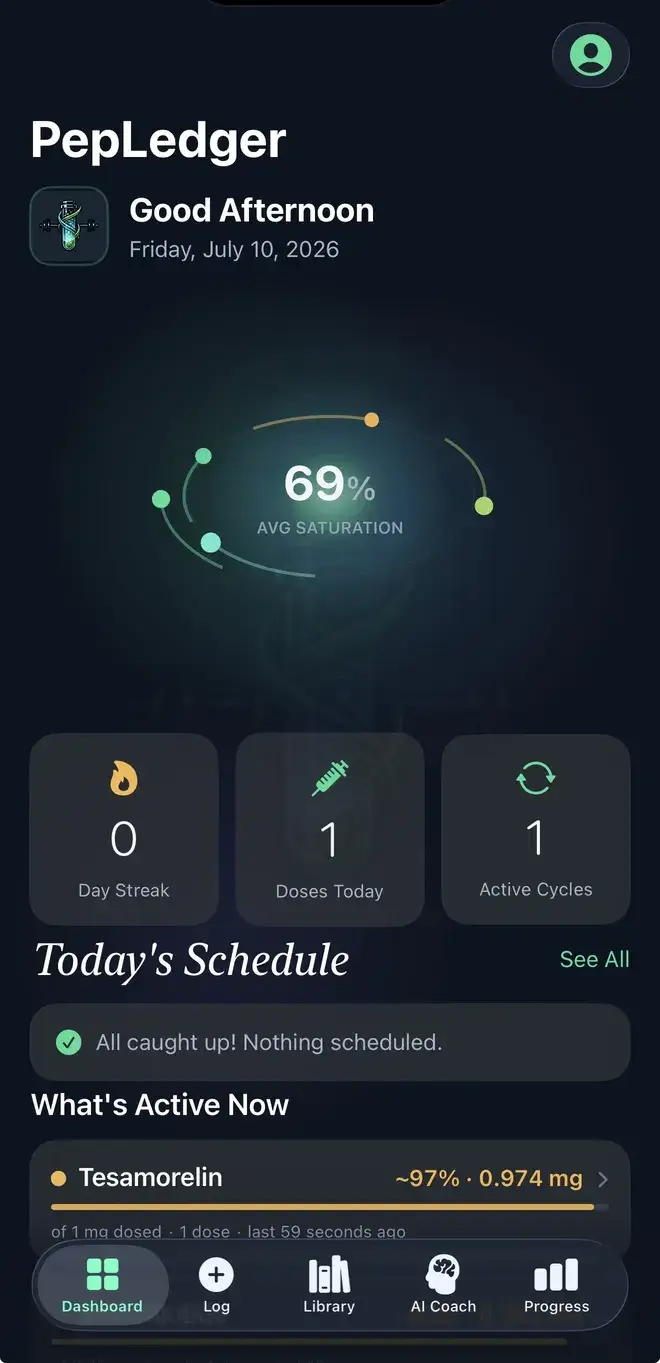
Separate a TB-500 event from its notes
A TB-500 history benefits from orderly notes because an event can blur together with inventory, label, and site information. PepLedger provides a private iPhone place to preserve user-entered details in a timeline. TB-500 has no FDA-approved dosing or titration schedule; a daily, weekly, or custom cadence in a history is not a PepLedger instruction. Any active display is a mathematical estimate, not a lab result.
For each completed event, enter the reference name, amount, unit, date, time, method, and site. Add label wording, source, container details, or why a record was corrected in a note. Inventory can include a user-entered lot reference or expiration date. A reminder can prompt review. These organizational fields do not verify contents, storage, identity, quality, or safety.
Inspect the TB-500 arithmetic trail
The TB-500 reconstitution calculator can expose arithmetic from a labeled amount, liquid volume, and syringe scale that you enter. It does not identify a container or determine whether an output should be used. Preserve original values beside a result. The printable shot logs are an offline alternative for recording the same kind of user-entered history.
Check chronology before relying on it
Scan for a repeated date, a unit that changed without explanation, or an intended event entered as completed. Add observations or dated measurements as their own records. A later measurement near a TB-500 event is not proof of cause, and PepLedger does not diagnose or interpret it. An active estimate is conditional on user-entered dates, units, and a configured assumption; it is not a blood concentration, safety assessment, effectiveness statement, or individualized model.
All meaningful facts are supplied by the user: name, amount, unit, date, time, method, site, inventory note, source note, observation, or lab value. PepLedger does not independently check them and does not claim to validate TB-500 or anything recorded under that name. Read About PepLedger, the methodology, and the Privacy Policy.
A private record with defined limits
The app is for iPhone and iPad on iOS 18 or later, not a clinic record or medical device. Current Pro features and pricing appear in the app. Open the official PepLedger App Store listing. PepLedger does not sell TB-500, validate a product or treatment, or advise an amount or timing. This page is informational, not medical advice.
Keep TB-500 corrections visible
A useful TB-500 handoff starts with a narrow date range and identifies the source for each field. Mark unknown information as unknown. If an event was entered late or a unit was corrected, preserve that history in a note rather than presenting a polished timeline as certainty. This gives a later reader a fair account of the record’s strengths and gaps.
PepLedger can organize questions about a record, but it cannot tell whether TB-500 is genuine, suitable, or safe, and it cannot convert an arithmetic display into personal direction. Its role is to retain user-entered facts and show their context. A qualified professional remains responsible for answering personal health questions.
If a history is copied into another record, preserve the source date and the date of transcription. Note a missing detail instead of supplying a guess. These small habits make a TB-500 record easier to audit while keeping responsibility for its facts with the person who entered them. They also keep an old paper note from being mistaken for a newly observed result. A clear source trail is more useful than extra certainty. Record whether a detail came from a label, a personal note, or a later transcription, and keep those origins distinct during review. The app can preserve that provenance without judging it. This keeps organization separate from endorsement and keeps a personal log distinct from product documentation. It also makes later questions more precise. Good provenance matters when entries are revisited over time, including after a correction.